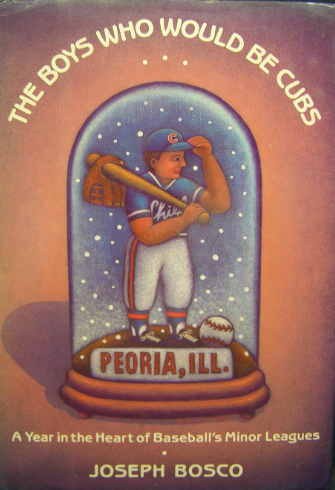
I’m going to let the cat out of the bag right away: this was not a good book, and it almost exclusively falls on its author, Joseph Bosco. You know the sort of writer who can’t help but write a phrase within a phrase, within a phrase, within a phrase while writing a sentence? That’s Bosco, and for 300+ excruciating pages, he spends run-on after run-on sentence describing people, places, and things in that mind-numbing manner. It was legitimately hard, at times, to know who or what he was addressing. His writing style is so overwrought and needlessly padded out that I didn’t feel like I was engaging in a conversation, but rather some dude lecturing me as I loll off to sleep.
I can forgive The Boys Who Would Be Cubs: A Year in the Heart of Baseball’s Minor Leagues for its deep misunderstanding of minor league baseball. The period of the 1980s was one where folks hadn’t yet grasped how the minor leagues weren’t the same minor leagues as in years past. Wins and losses didn’t matter one iota by that point, and try as he might, Bosco couldn’t make the reader believe that it honestly mattered how the 1988 Peoria Single A ballclub did in the win-loss column. The reality is that Jim Tracy and others in the organization thought winning and losing mattered as much as the book lets on; well, they likely didn’t help their players advance up the ladder all that much. To be clear, I don’t agree with the way the modern minor leagues are structured, but they are structured so that winning and losing aren’t a part of the equation; that’s a fact.
It was a struggle to get past some of the wrongheaded thoughts on baseball. How many great players were sidelined because Tracy felt they needed to stop being patient at the plate? There’s a section of the book where he decries Rick Wilkins walking as much as he did in the 1988 season. Why, because walks don’t score runs, which, yeah. I get it, baseball hadn’t really woken up by 1988, people still thought walks were bad, pitcher wins/losses mattered, and everything you needed to know about a hitter was contained in his batting average. That still doesn’t make such Luddite thinking about the game of baseball any easier to read.
The Boys Who Would Be Cubs: A Year in the Heart of Baseball’s Minor Leagues was a slog to get through. I was happy when it was over, which sucks because everyone reading this knows I love books about minor league and unaffiliated baseball. At the end of the day, The Boys Who Would Be Cubs: A Year in the Heart of Baseball’s Minor Leagues isn’t just a boring book; it’s a badly written book and one any minor league baseball fan can easily avoid.
Lead image courtesy of Unknown – William Morris & Company