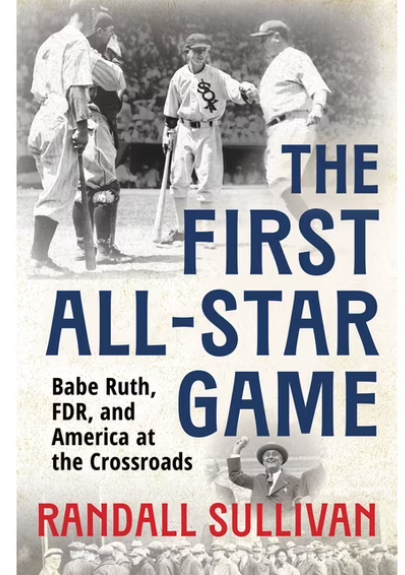
Sometimes an author swings big and misses by only a little. Such was the case with Randall Sullivan’s first full-length baseball effort. The First All-Star Game: Babe Ruth, FDR and America at the Crossroads has grandiose aims, and at times it teeters oh so close to meeting those aims. Unfortunately, at every turn, Sullivan simply fails to do the legwork to tie all the disparate elements of his history book together. The result is a grouping of interesting stories that exist within their own universe, never to actually cross paths with one another.
For some, perhaps they won’t be bothered by the isolation found within the stories Sullivan is spinning. I couldn’t get past that aspect of the book. I kept waiting and hoping that Sullivan was about to tie his earlier explorations of Franklin Roosevelt into the actual all-star game (or at least the build and repercussions of the game), but alas, that was not to be. The Great Depression exists, Babe Ruth exists, and so does FDR, but they run parallel to one another as opposed to intersecting in any meaningful manner. I can see where folks could argue that they do intersect. But, simply writing that those things existed at the same time doesn’t tell the story of why they mattered to one another, how they affected one another, how they didn’t, etc.
I wanted more than separate stories boxed off as if they exist in some sort of arcane filing system. Not to mention more than a shoehorned in chapter in the Negro Leagues that features an appalingly historically inaccurate statement that the Negro Leagues weren’t major leagues. But Sullivan wasn’t up to delivering more than that. That’s unfortunate, because it is clear that Sullivan is a decent historian (albeit a bit of a misguided baseball statistician with his continued pushing of batting average as a definitive statistic of merit, or lack thereof), though one who sees the small picture as opposed to the big picture.
Maybe my expectations were too high, but The First All-Star Game: Babe Ruth, FDR and America at the Crossroads is a title that leads one to think of a grander scope than was present. This is a history book; it even presents a wide view of baseball and world history as seen in the 1920s-1930s. Sullivan tries to cast a wide net of the era. Those eyes are bigger than his stomach, and the result is a wholly unsatisfying meal.
Lead image courtesy of Unknown – Atlantic Monthly Press